AI does not eliminate
coordination.
It makes coordination
measurable.
Token Learning Control helps enterprises govern AI execution through measurable operating discipline, token allocation, runtime controls, and financial accountability.
Built for CEOs, CFOs, CIOs, CTOs, and AI Product transformation leaders.
The Problem
Most AI programs fail
after the pilot stage.
Organizations can measure AI activity. Very few can measure AI accountability. Token spend grows, governance fragments, attribution disappears, and runtime execution scales faster than operating discipline.
Token spend without attribution
AI usage becomes visible, but organizations cannot connect token consumption to measurable business contribution.
AI pilots without kill conditions
Experiments continue indefinitely because ownership, success criteria, and retirement rules were never formally defined.
Runtime agents without governance
Autonomous execution scales before escalation rules, boundary conditions, and operational controls exist.
Productivity claims without financial accountability
Teams report AI acceleration while leadership still lacks portfolio-level visibility into ROI and execution economics.
The Compression Thesis
Organizations compress when coordination becomes measurable.
AI changes organizational economics because execution becomes cheaper than coordination. As AI systems absorb execution work, organizations shift toward smaller control structures with greater operating visibility.
Token Learning Control provides the operating discipline required for AI-native organizational compression.
Direction
Strategic governance and operating mandate
Control
Token allocation, attribution, and accountability
Execution
Governed runtime with measurable output discipline
The Operating System
The operating system for governed AI execution.
TLC connects governance, token allocation, runtime controls, and financial accountability into one closed-loop operating model.
Feature Governance
Every AI feature in production carries a structured record of its token ceiling, success criteria, and kill conditions.
Token Capacity Planning
Cognitive compute is allocated per sprint the same way financial capital is allocated — with limits, forecasts, and accountability.
Organizational Mandate
Migration decisions, system retirements, and consolidations are authorized through a formal governance mandate — not left to drift.
Measurement
Token Velocity™ and output attribution create the core signal for AI execution efficiency across features and teams.
Runtime Governance
Escalation rules, boundary conditions, and operational controls govern autonomous AI execution in production environments.
Tokenomics P&L
AI inference cost becomes a financial line item — linked to revenue contribution and surfaced at the portfolio level.
Core Instruments
Each instrument replaces something broken.
Feature Ledger
Governs
Every AI feature in production — its token ceiling, success criteria, and kill conditions.
Replaces
Informal feature tracking and undocumented AI workloads with no accountability fields.
Links every AI feature to measurable business impact — not activity.
Token Capacity Planning
Governs
Sprint-level allocation of cognitive compute across features, teams, and use cases.
Replaces
Uncapped AI spend and unlimited token consumption without organizational governance.
Converts AI compute from a utility expense into a governed capital allocation.
Migration Mandate
Governs
Decisions to retire, replace, or consolidate AI systems before they accumulate debt.
Replaces
Informal migration conversations and deferred system retirements without authorization.
Creates organizational authority for AI system decisions — and a record of why they were made.
Token Velocity™
Governs
Output-per-token ratios by feature and team over time.
Replaces
Qualitative AI productivity claims with no measurable execution signal.
The core efficiency signal for AI execution — revealing value creation and waste simultaneously.
Runtime Governance
Governs
Autonomous AI execution in production — escalation rules, boundary conditions, and controls.
Replaces
Unmonitored agent execution with no operational oversight or intervention structure.
Ensures that AI systems operating autonomously remain within defined operational boundaries.
Tokenomics P&L
Governs
AI inference cost as a financial line item linked to revenue contribution and portfolio ROI.
Replaces
AI cost as an IT infrastructure expense invisible to financial governance.
Financial accountability for every AI investment — surfaced at the level finance can govern.
Financial Accountability
AI becomes material when token spend becomes financial exposure.
Once AI execution reaches enterprise scale, token consumption becomes an operational and financial governance problem. TLC introduces attribution, portfolio visibility, runtime accountability, and measurable execution economics.
Investment Signal
Which AI capabilities deserve additional allocation?
Token Velocity™ and attribution data reveal which features generate measurable output relative to token consumption — identifying where additional investment produces compounding returns.
Efficiency Signal
Which systems consume disproportionate tokens relative to delivered value?
Portfolio-level tokenomics visibility surfaces waste before it becomes entrenched — enabling allocation shifts away from low-yield AI execution toward higher-return operating capacity.
Organizational Signal
Where does coordination cost exceed execution value?
When token spend maps to organizational output, the systems that produce coordination overhead rather than execution value become visible — and eliminable.
Start Here
Start with the operating artifacts.
Receive the TLC Starter Kit for diagnosing Coordination Debt™, governing AI execution, and establishing measurable operating discipline.
The Strategic Foundation
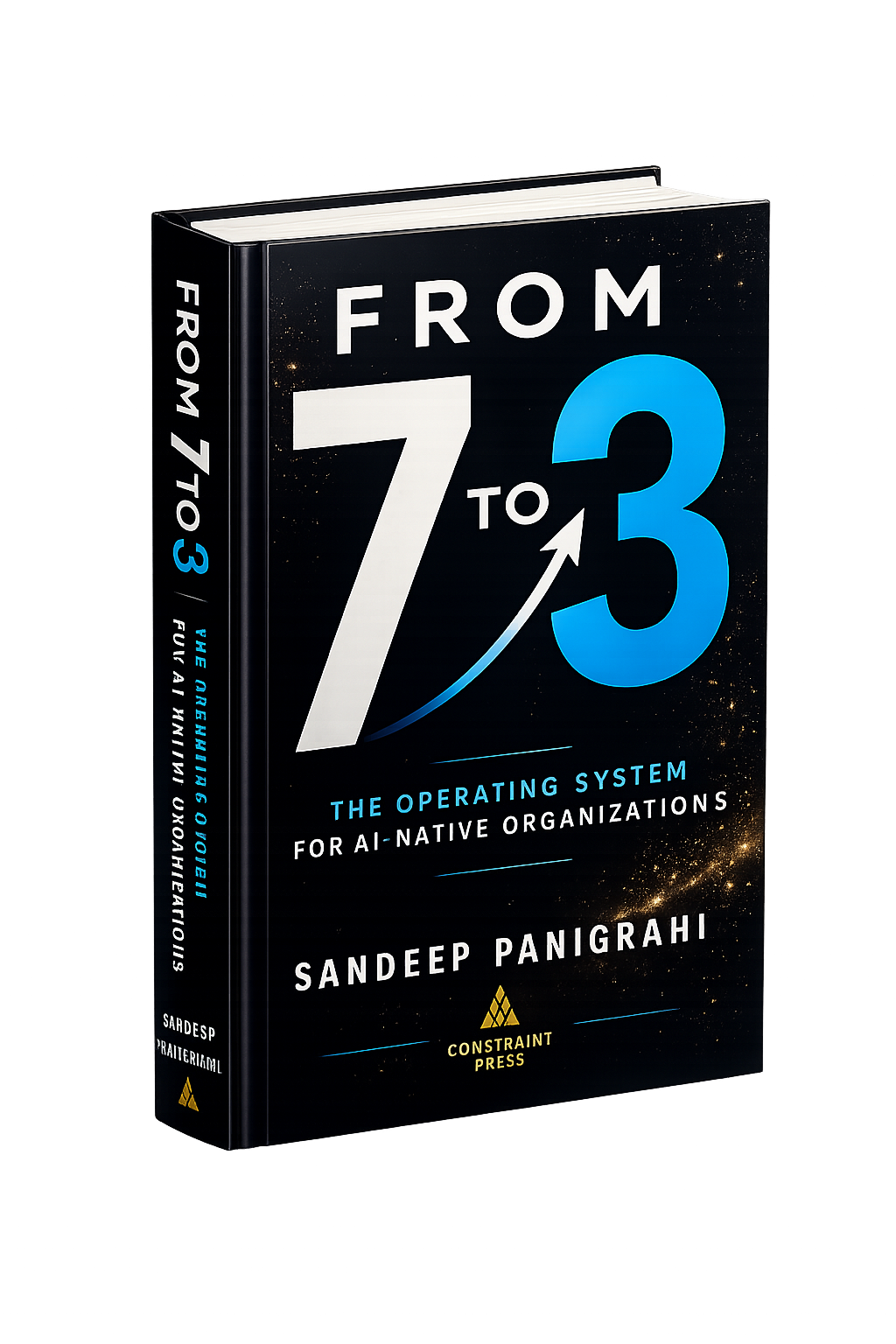
From 7 to 3
From 7 to 3 is the strategic foundation behind the Token Learning Control operating system — explaining how organizations compress as coordination becomes measurable.
Not a how-to guide for AI implementation. A governance model for organizations that have already deployed AI and now need to understand what they built.